What Are the Most Common Reasons a Deck Fails Inspection?
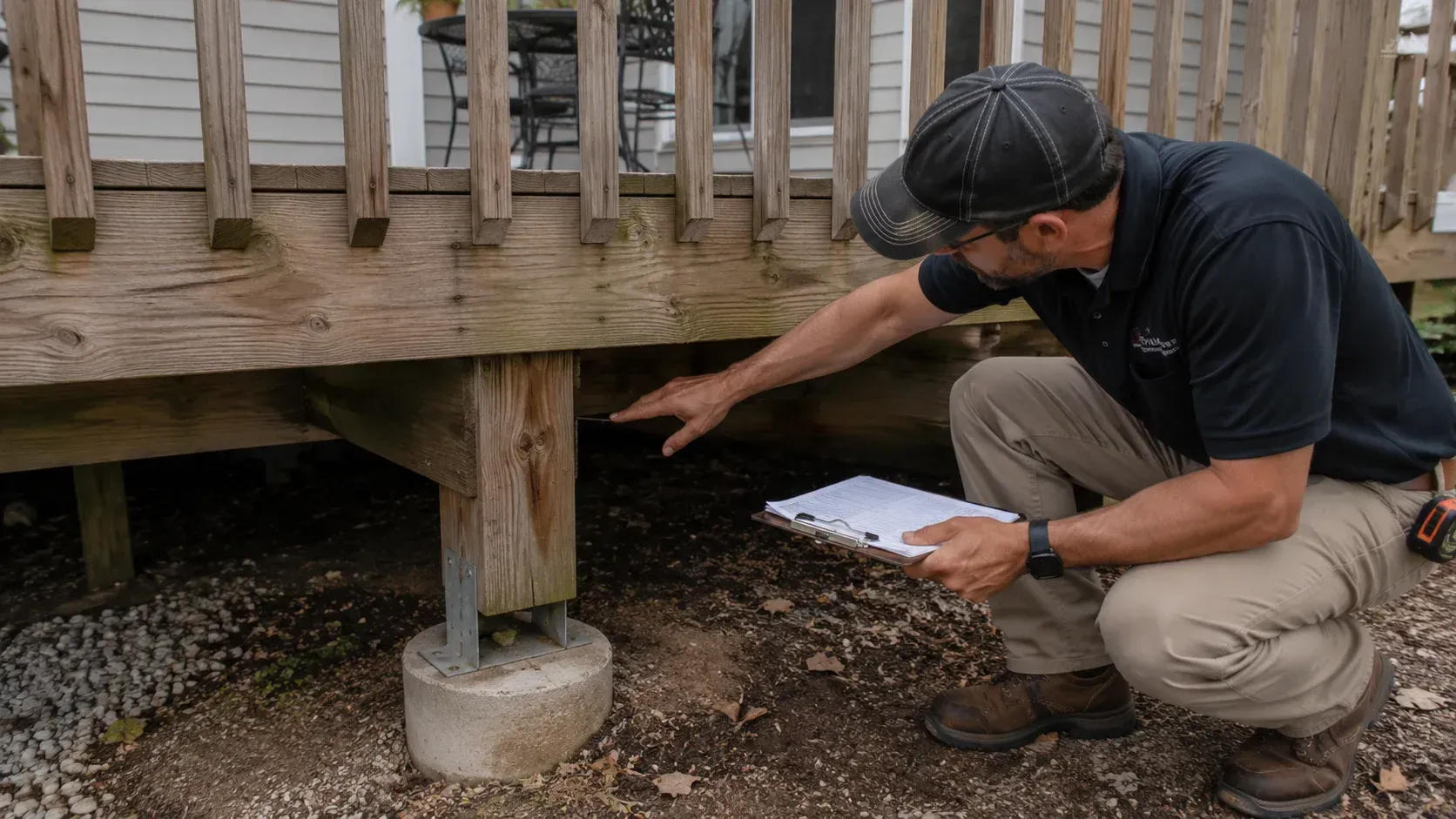
Table of Contents
- Why Do Decks Fail Inspection?
- The Ledger Board Connection
- Footings and Posts
- Railings and Guards
- Stairs and Stringers
- Fasteners, Hardware, and Connections
- Joists, Beams, and Structural Framing
- A Pre-Inspection Checklist
- Repair, Rebuild, or Call a Pro: A Decision Framework
- Common Misunderstandings About Deck Inspections
- A Realistic Springfield Scenario
- What Typical Online Advice Overlooks
- Conclusion
- Frequently Asked Questions
Key Takeaways
- The most common reasons a deck fails inspection are structural: a poorly attached ledger board, undersized or shallow footings, loose or low railings, unsafe stairs, and the wrong fasteners or connectors.
- Many failures trace back to how the deck connects to the house and the ground, not to the deck boards you can see, which is why cosmetic condition is a poor guide to whether a deck will pass.
- The ledger board connection, where the deck attaches to the house, is one of the most frequently cited problems and one of the most dangerous when done wrong.
- Local codes set the specific numbers for railing height, baluster spacing, footing depth, and joist spacing, and those requirements can vary, so the local building department is the authoritative source.
- Catching problems before an official inspection is almost always cheaper and safer than discovering them after a failure, especially for older decks or ones built without a permit.
Why Do Decks Fail Inspection?
Decks most often fail inspection because of structural problems with the parts that hold the deck up and keep people from falling off it: the ledger board connection to the house, the footings and posts, the railings, the stairs, and the fasteners tying everything together. Cosmetic issues rarely fail a deck. Safety and structure do, which is why knowing when a problem calls for professional deck repair matters before an inspection, not after.
An inspection is not judging whether your deck looks nice. It is checking whether the deck can carry the loads it will face, people, furniture, snow, and stay standing and safe over time. That means the inspector is looking at connections and framing that most homeowners never think about.
This matters for two groups in particular. Homeowners selling a house or pulling a permit for a new deck will face an inspection directly. Business owners with a deck, patio, or elevated seating area open to customers carry added responsibility for public safety. In both cases, understanding what inspectors evaluate helps you fix problems before they become failures rather than after.
A note on specifics: building codes set the exact numbers, and they can vary by jurisdiction and change over time. Treat any figure in this article as a general reference and confirm current requirements with your local building department in Springfield.
The Ledger Board Connection
The ledger board is the piece that attaches the deck to your house. It is one of the most frequently cited inspection problems and one of the most serious, because a failed ledger connection is a leading cause of deck collapses.
The common failures are straightforward. Some decks are attached with nails instead of proper structural fasteners or lag screws, and nails can pull out under load. Others lack flashing, so water gets behind the ledger and rots both the board and the house framing it is bolted to. And some are attached to the wrong part of the house entirely, such as a rim joist never meant to carry a deck. Because the ledger carries a large share of the deck's weight, a weak connection or rotting wood behind it puts the whole deck at risk, and inspectors look closely here.
What inspectors check: proper structural fasteners, correct spacing, and flashing that directs water away from the house. If you cannot see how the ledger is attached, or you see staining or rot near it, that is a sign to get it evaluated.
Footings and Posts
Footings are the concrete bases that transfer the deck's weight into the ground. Posts sit on the footings and hold up the beams. When either is undersized, too shallow, or improperly connected, the deck can settle, shift, or become unstable.
In a climate with real winters like Springfield's, footing depth matters because of frost. Footings that do not reach below the frost line can heave when the ground freezes and thaws, pushing parts of the deck up and out of level over time. Shallow or undersized footings are a common finding on older decks and DIY builds.
Posts fail inspection when they are not properly anchored to the footing, when they rest directly on soil or on top of the ground where they wick up moisture and rot, or when they are notched or damaged in ways that weaken them. A post that simply sits on a patio stone without a proper connection is a frequent problem.
What inspectors check: posts secured to footings with proper hardware, posts that are not in direct ground contact, and footings sized and set deep enough for the load and the local frost depth.
Railings and Guards
Railings, or guards, keep people from falling off an elevated deck, so inspectors examine them carefully. Failures here are extremely common and often easy to spot.
The usual problems: railings that are too low, gaps between balusters that are too wide, and railings that are loose or wobbly. Codes specify a minimum guard height for decks above a certain height off the ground, and a maximum spacing between balusters, often small enough that a specified sphere cannot pass through, which is meant to keep children from slipping through or getting stuck.
Why this fails inspection: a railing that is too low, too loose, or too open does not do its one job, which is preventing falls. Loose railings are also a sign of deeper attachment problems.
What inspectors check: guard height, baluster spacing, and how solidly the railing posts are attached to the deck framing. A railing you can rock by hand will not pass, and it is a genuine safety hazard regardless of inspection.
Stairs and Stringers
Deck stairs are a frequent failure point because they take heavy use and involve several code-specific measurements.
Common issues include inconsistent step height or depth, which is a trip hazard; stringers (the angled boards that support the steps) that are undersized, cracked, or poorly attached; missing or non-compliant handrails; and the bottom of the stairs resting on soil or an inadequate landing. Stairs over a certain number of steps typically require a graspable handrail.
Why this fails inspection: stairs are where falls happen. Uneven steps, weak stringers, and missing handrails all raise the risk, so inspectors hold them to specific standards.
What inspectors check: consistent riser height and tread depth, solid stringer attachment, a proper landing at the bottom, and a compliant handrail where required.
Fasteners, Hardware, and Connections
The right connection at each joint is what turns a pile of lumber into a safe structure, and using the wrong hardware is a common reason decks fail.
Typical problems: interior screws or nails used outdoors where they corrode, hardware not rated for contact with modern pressure-treated lumber (which can corrode the wrong metals), missing joist hangers or hangers attached with the wrong nails, and connections that rely on nails where structural screws or bolts are required. Corroded or under-spec fasteners weaken over time, and a connection is only as strong as the hardware holding it.
What inspectors check: exterior-rated, corrosion-resistant fasteners and connectors; joist hangers fully nailed with the correct hanger nails; and structural bolts or screws where the load demands them.
Joists, Beams, and Structural Framing
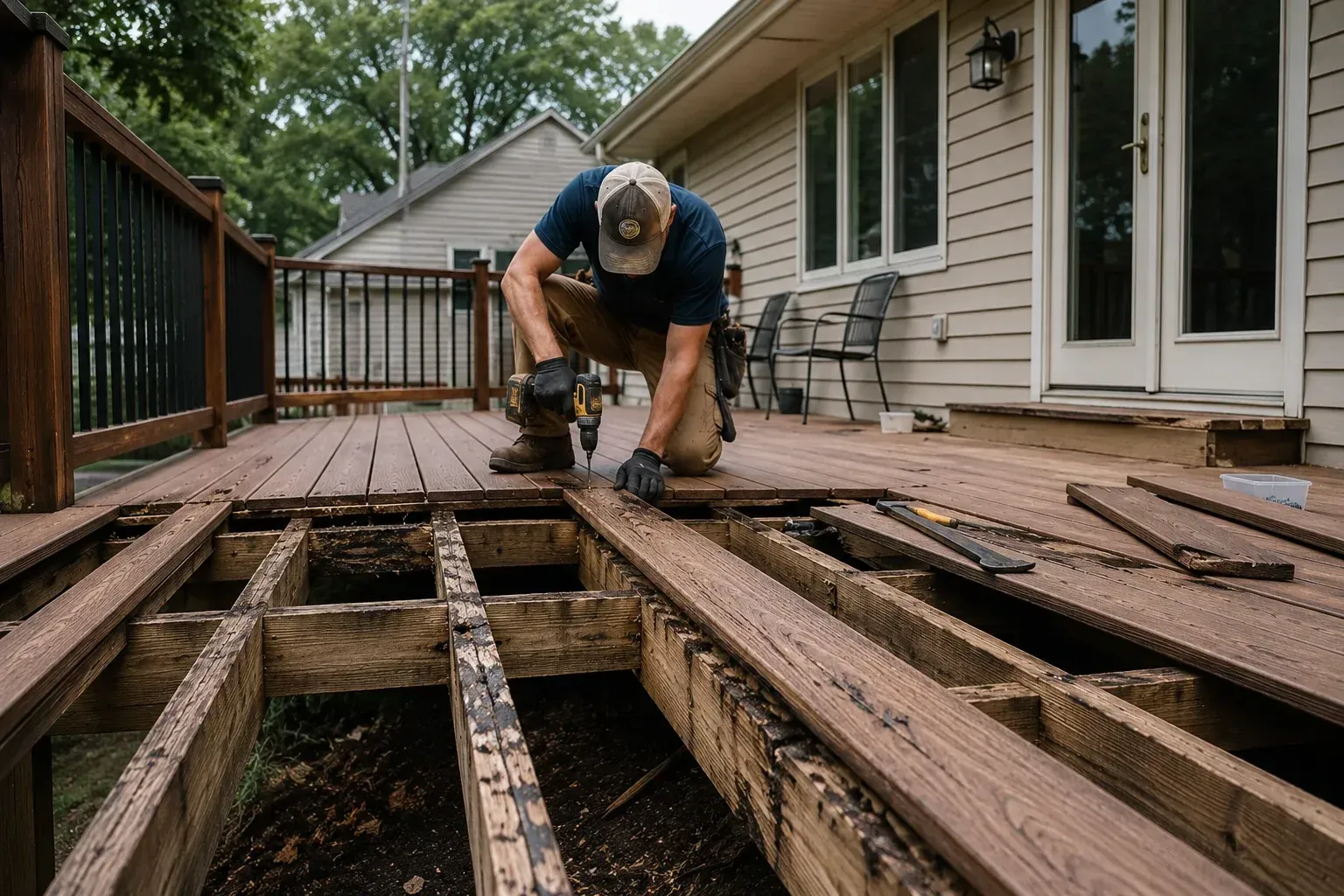
The framing under your deck boards, the joists and beams, carries the load. Problems here are less visible but just as important.
Common failures include joists spaced too far apart for the decking, beams undersized for the span, spans that are too long without adequate support, rot or insect damage in framing members, and notching or drilling that weakens a beam or joist. Decking that feels bouncy underfoot often points to joist spacing or span issues. Undersized or overspanned framing can sag, crack, or fail under load, and rot compromises strength regardless of how the deck looks on top.
What inspectors check: joist spacing appropriate for the decking material, beam and joist sizing suited to the span, solid (not soft or spongy) wood throughout, and no structurally significant notching. If you are planning a new build, sound deck building practices and correct framing sizes prevent these problems from the start.
A Pre-Inspection Checklist
Walk your deck with this list before an official inspection. It will not replace a professional evaluation, but it helps you spot obvious problems.
- Ledger: Is the deck bolted to the house with structural fasteners, not nails? Is there flashing? Any staining or rot near the attachment?
- Footings and posts: Are posts anchored to footings with hardware? Are any posts sitting directly on soil or on the ground? Is the deck level and stable, with no sagging?
- Railings: Is the guard tall enough, are baluster gaps narrow enough, and are the railings solid when you push on them?
- Stairs: Are the steps even in height and depth? Is there a handrail where the run requires one? Are the stringers solid and well attached?
- Fasteners and hardware: Do you see rusting or corroded fasteners? Are joist hangers present and fully nailed?
- Framing: Does the deck feel bouncy or soft anywhere? Any visible rot, cracks, or major notching in the joists or beams?
- Overall: Any wobble, movement, or soft spots when you walk the deck?
If several of these raise concerns, or if the deck is older or was built without a permit, a professional assessment is the sensible next step.
Repair, Rebuild, or Call a Pro: A Decision Framework
When you find a problem, the next question is what to do about it. Work through these steps.
| Step | Question | What it points to |
|---|---|---|
| 1. | Is the problem cosmetic or structural? | Cosmetic issues rarely affect inspection. Structural ones need real attention. |
| 2 | Is it a single, isolated fix (one loose railing, a few fasteners)? | An isolated, non-structural fix may be a manageable repair. |
| 3 | Does it involve the ledger, footings, or main framing? | These are load-critical. Get a professional evaluation before acting. |
| 4 | Is there rot, or is the deck near the end of its lifespan? | Widespread rot or age often makes rebuilding more sensible than patching. |
| 5 | Was the deck built without a permit, or do you not know its history? | Unknown history is a reason for a full professional inspection, not a guess. |
keep people from falling, the stronger the case for professional help rather than a DIY patch. Railings, ledgers, footings, and framing are not the place to guess.
Conclusion
Decks fail inspection for structural reasons far more than cosmetic ones. The recurring culprits are the ledger board connection to the house, undersized or shallow footings, loose or low railings, unsafe stairs, the wrong fasteners, and compromised framing. Almost all are hidden beneath or behind the deck, which is why a good-looking deck can still fail and why surface condition is a poor guide to safety.
The most useful mindset is to think about connections and loads rather than appearance. Ask how the deck attaches to the house, how it meets the ground, and whether the railings and stairs will keep people safe. Those questions point straight at the things inspectors check.
For homeowners and business owners in Springfield, two things carry the most weight: catch problems before an official inspection, and confirm the specifics with the local building department rather than a generic source, since codes vary. Finding an issue early, while it is still a repair and not a failure, is nearly always the cheaper and safer path.
Talk Through a Deck Safety Inspection in Springfield, MO
If you are unsure whether your deck would pass, or you have spotted a problem and are not sure how serious it is, a straightforward assessment removes the guesswork. Questions about a deck safety inspection, common inspection problems, or what a specific issue means for your deck in Springfield, MO are worth asking before you buy materials or list a home. You can
contact us to talk through your deck's specifics. Clear information up front helps you plan the right work at the right time, with no pressure.
Frequently Asked Questions
What is the most common reason a deck fails inspection?
Structural connection problems are the most common, especially a ledger board attached with nails instead of proper fasteners or missing flashing. Because the ledger carries much of the deck's load, inspectors examine it closely and a weak connection is both a frequent and serious failure.
Can a deck that looks fine still fail inspection?
Yes. Appearance and structural safety are separate. A deck with new boards and fresh stain can still have undersized footings, a weak ledger, or corroded fasteners hidden underneath. Inspectors focus on structure and safety, not looks.
Do I need a permit and inspection to build a deck in Springfield?
Most areas require a permit and inspection for new decks, but specifics vary by location and project. Check with the Springfield building department before starting. Working with a builder who handles permitting can help ensure the deck meets current local code.
How often should a deck be inspected for safety?
A general guideline is to check a deck yearly for loose railings, soft spots, and corroded hardware, with a closer look before selling, after major storms, or if the deck is older. Older decks and those built without a permit warrant more attention.
Is it cheaper to repair or replace a deck that fails inspection?
It depends on the extent of the problems. Isolated, non-structural issues are usually worth repairing. Widespread rot, multiple structural failures, or an aging deck often make rebuilding the more sensible long-term choice. A professional evaluation gives you real numbers to compare.
Recent Posts